Cost Management and Data Lifecycle on OCI Object Storage
📤 Compartilhe este artigo com o link curto:
The Challenge of Exponential Data Growth in the Cloud
In modern enterprise environments, the volume of data generated daily by applications, system logs, database backups, and media files grows at a dizzying pace. If not managed correctly, cloud storage costs can skyrocket unsustainably. In Oracle Cloud Infrastructure (OCI), the Object Storage service offers a highly scalable, durable, and secure solution for unstructured data storage.
However, storing audit logs from five years ago in the same high‑performance tier where active transactional data resides is a severe financial waste. It is precisely to solve this problem that we use Object Storage Lifecycle Rules.
Storage Tiers: Standard vs. Infrequent Access
OCI Object Storage provides different storage tiers designed to balance access performance and financial cost:
- Standard Tier: Designed for active data that requires frequent, immediate, and high‑performance access. It has the highest cost per gigabyte but offers instant read and write rates with no additional retrieval charges.
- Infrequent Access Tier: Designed for data that is accessed rarely (such as old backups or historical files) but needs to be available for fast retrieval when necessary. It offers significantly lower storage cost with a small retrieval fee charged only when data is accessed.
- Archive Storage: The most economical cloud option for long‑term retention (compliance and legal auditing). While storage cost is minimal, data requires a rehydration period (usually a few hours) before becoming available for download.
Automating Management with Lifecycle Rules
Manually moving millions of files between different buckets or tiers would be an operationally unfeasible and error‑prone task. OCI Lifecycle Rules automate this process through time‑based policies.
You can configure declarative policies directly in the OCI console or via CLI that execute automatic actions such as:
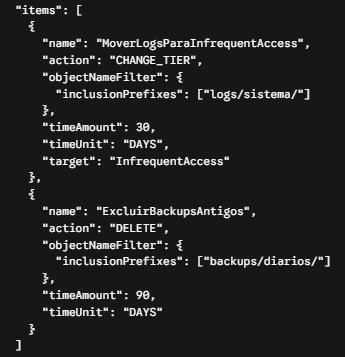
- Automatic Tiering: Move objects that have not been modified for more than 30 days from the Standard tier to the Infrequent Access tier.
- Automatic Deletion: Permanently delete temporary log or cache files after 90 days of creation, freeing up space and ensuring compliance with corporate retention policies.
Example lifecycle rule configuration via JSON:
Storage Governance Best Practices
- Audit data access profiles: Evaluate with your development team which files truly require instant availability and which can tolerate retrieval times in colder tiers.
- Combine with Object Versioning: When enabling object versioning for protection against accidental deletions, remember to configure specific lifecycle rules to purge old (noncurrent) versions after a certain period.
Conclusion
Implementing intelligent lifecycle policies in OCI Object Storage allows the company to maintain absolute rigor in historical data retention while drastically reducing operational cloud infrastructure costs.