The Essential SQL You Need to Know: From Zero to Optimized
📤 Compartilhe este artigo com o link curto:
If you work with technology, development, or enterprise systems support, at some point you will need to query, cross‑reference, or adjust data stored in a relational database. Mastering SQL (Structured Query Language) is not just about knowing how to write a simple SELECT, but understanding how data relates and how the database engine processes that information efficiently.
Below, we break down the fundamental concepts every professional needs to master to write clean, secure, and high‑performance code.
1. The Foundation: The SELECT Command and Correct Filtering
Every analytical interaction begins with data retrieval. However, the most common error in production environments is the lack of restrictive filters, which causes high I/O consumption on massive tables.
- SELECT and FROM: Define which columns and from which table the data will be extracted.
- WHERE vs HAVING: Always use WHERE to filter rows before grouping. HAVING should be reserved exclusively for filtering the result of aggregate functions (like SUM or COUNT after a GROUP BY).
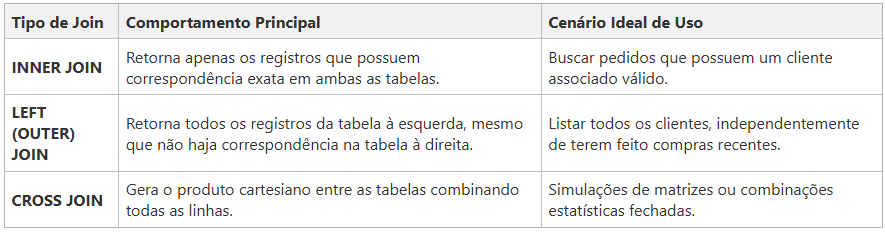
2. Relating Tables: Joins Explained
Enterprise systems normalize data across multiple tables to avoid redundancy. To join this information, we use JOIN operators.
3. Grouping and Analytical View (GROUP BY)
When we need to transform raw rows into management indicators, we turn to aggregations. Functions like COUNT(), SUM(), AVG(), MAX(), and MIN() organize the data volume.
SELECT categoria_id, COUNT(id) AS total_produtos, AVG(preco) AS media_preco FROM produtos WHERE status = 'ATIVO' GROUP BY categoria_id;
4. Performance and Best Practices in Production
Reducing processing time for complex queries requires attention to architectural details:
- Avoid SELECT *: Requesting unnecessary columns consumes network bandwidth and prevents the database from using column‑covering indexes.
- Be careful with functions on indexed columns: Applying functions like UPPER(column) or YEAR(date) on the left side of a WHERE clause invalidates the use of conventional indexes (Full Table Scan).
- Execution Plan Analysis: Always use tools like Explain Plan (on Oracle) or equivalent commands to understand where processing cost is concentrated.
Understanding these pillars transforms the way you interact with databases, shifting the focus from reactively fixing bottlenecks to proactively designing stable and performant solutions from the first line of code.